
Kept Appointment Reports
Kept Appointments; Kept Appointments with No Treatment Chart
Run a Kept Appointment report to see which patients have kept certain appointment procedures on a specific date, or within a date range. Choose from multiple report formats, each designed to show different information about your patients and your practice. For example, the Kept Appointments report provides for selecting only appointments for certain procedures, and can include medical alerts. Also, you can use the Kept Appointment - No Treatment Chart report to be sure that no appointments are accidentally left uncharted.
Run This Report
-
Open the Report
- Home ribbon bar > Reporting section > Reporting > Appointment > Kept Appointments or Kept Appointments with no Treatment Chart > Run. (You can also use the Search field to find the report you want to work with.) You might also be able to run this report or form from your Recent Reports or Quick Reports list. See "Run Edge Cloud Reports" for details.
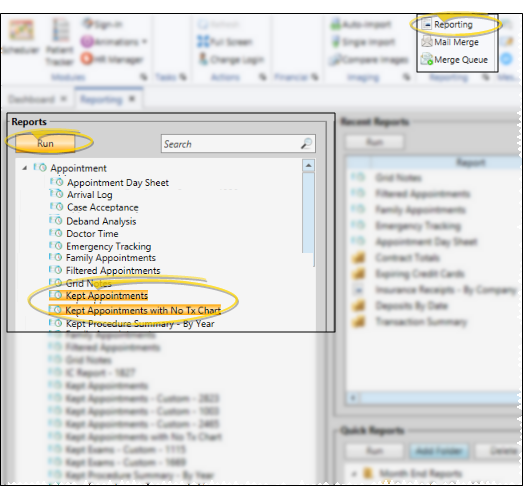
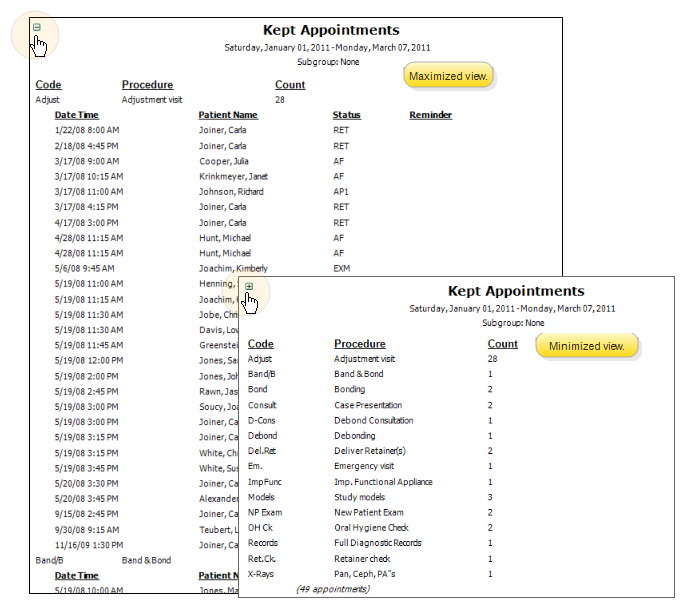
Kept Appointments - This report prints details the patients who kept their appointments during the date range you select. In addition to other report options, you can choose to include only certain types of procedures, only the patients assigned to a specific office or orthodontist, and optionally include patient alerts on the report. You can minimize the report to show a simple summary of the number of each type of procedure have been kept, or maximize the report to show details about each patient appointment.
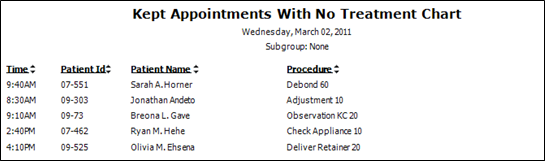
Kept Appointments with No Treatment Chart - This report prints patients who kept their appointments on a specific date, but have no treatment chart record created for that appointment yet.
-
Choose Report Settings
- Select the options to use for choosing records and generating this report. Choose carefully, as your selections will affect which patients are included in the report. (If the settings panel is not visible, click the Show/Hide icon in the upper left corner of the Reporting window.)
Date Range or Smart Date - Enter the range of dates to include on this report, or select a single date for both the Start Date and End Date fields to run the report for an individual date. You can type a date in the fields, or click the calendar icon to select a date. You can also enable a Smart Date option to automatically calculate the dates for you. When a Smart Date is enabled, any dates you enter manually are ignored. Your selected date or date range will appear just under the report title when you view your report; if you select a date that is not today, this date will be different than the run date that appears in the report header.
(Does not apply to the No Treatment Chart report.) Procedure - Select one or more procedures (from your Appointment Procedure Types editor) to include on the report, or choose to include "All" procedures.
(Does not apply to the No Treatment Chart report.) Initial Sort Order - Choose how to sort the results when the report is first displayed on your screen. While viewing the report, you can click nearly any column heading to re-sort the data.
(Does not apply to the No Treatment Chart report.) Office - Choose to include only the records for a specific office, or include the records for all office locations in your practice.
(Does not apply to the No Treatment Chart report.) Orthodontist / Doctor - Choose to include only the records for a specific orthodontist / doctor, or include the records for all orthodontists in your practice.
(Does not apply to the No Treatment Chart report.) Recall Procedures Only - Enable this option to include only recall appointments on the report (these are appointments that remind patients to call to schedule an appointment). Regular scheduled appointments will be ignored. If this option is disabled, recall appointments are ignored and will not be included.
(Does not apply to the No Treatment Chart report.) Hide Medical Alerts - Disable this option to display medical alerts underneath the procedure description. If this option is enabled, medical alerts will be omitted. (See "Patient Alerts" for details.)
-
Subgroup - You can optionally choose a subgroup to use to narrow the records to include on the report. Only records that fit your selected subgroup as well as all other report settings will be included. If you use a subgroup, the report will display the name of your selected subgroup just under the report name, so you know which criteria was used to generate the results. See "Subgroup Editor" for details.about creating subgroups.
-
View Results - If needed, click View at the top of the report settings panel to view the results on your screen. When you run a report or form from your Recent Report list, or when you run a Quick Report, the initial results are sent to your screen immediately, with one exception: A Quick Report that has the Print Only option enabled will not show your results on the screen at all, but continue with the printing options.
-
Manage Options and Output - With the results on your screen, you can choose the output with the toolbar at the top of the report window. See "Report Output Options" for details.
More Information
Procedure column - The Procedure column shows you which procedure was scheduled for the appointment that was kept.
Report Title & Header - Whether you view the report on your screen or print it, the report title and run date appear in the header of each report page. If you used subgrouping or other report options, that information appears just under the report title so you know which criteria was used to generate the results.
(Does not apply to the No Treatment Chart report.)
Minimize / Maximize Information
- Click the [ + ] or [ - ] icon at the top of the report to toggle between viewing the report in maximized mode, showing patient details, and minimized mode, showing only summary information. The example at the top of this topic shows both viewing modes.

Use Arrows to Re-Sort Report
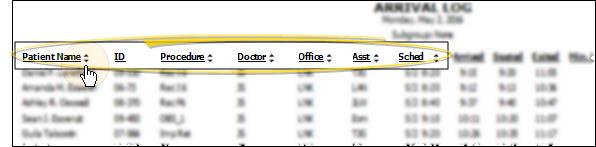
While viewing certain Edge Cloud reports, you can use the arrow beside certain column headings to re-sort the report according to that column's criteria. Click the arrows a second time to sort that column in reverse order, or click the arrows beside a different column to change the sort order again. (Not all Edge Cloud reports support this feature. If your cursor changes to look like a hand, the feature is available.)
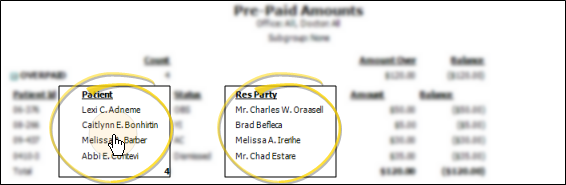
Open the Patient Folder / Responsible Party Record
While viewing some Edge Cloud reports, you can click a patient name or responsible party name to open that record. Not all Edge Cloud reports support this feature. If your cursor changes to look like a hand, the feature is available.
Automate Treatment Chart Entries - Use the Create Tx. Chart Entry workflow activity to open the Treatment Hub page of the patient folder, and add a new, blank treatment chart record ready for your input. This may help prevent patient charts from slipping through the cracks. See "Workflow Activities" for details.